Sunday, 4 August 2013

One less mzungu in the village


We were ready. Truthfully, we'd been ready for two hours. The invitation to Sandra's farewell party said from 6pm. It was now 8pm, no one had come to escort her to the party and we'd started listening to the Dixie Chicks to keep the mood up (James' choice). I was starting to doubt anyone would come to collect Sandra. Maybe they would just have the party without her.

Weeks ago, a committee had taken over the planning of Sandra's goodbye sherehe. She had wanted a small affair for some of her colleagues, friends, and the people whom she had grown close to during her year in Nyangao. But that is not the Tanzanian way. Parties are scheduled, ticketed events. End of. The committee chose the date, the venue, the caterer, the DJ, the decorations - we just paid for our cardi (entrance ticket) and waited for Sandra to be driven to the venue. Except that was two hours ago and there was still no sign of a party starting. We sent James down to the village to scout out the venue and see what was going on. He fed back - there were 3 people there. This was going to be a long night. A while later, a second message came - the music was pumping and more people had arrived. Finally, our neighbour and Sandra's boss, Dr Wambyakale drove up to our front door and took the two of us to Nhamo Garden Bar, which was only a 10 minute walk away on Nyangao's main (only) road. I felt like a bridesmaid escorting the bride to her wedding. Except when we arrived at Nhamo, I abandoned Sandra as soon as I could because she would have to dance in to the venue and I didn't want to be part of the procession.

With doctor-in-charge Max Makota and hospital Patron Edgar Chilembe, Sandra danced in to the bar to the soundtrack of Celine Dion. Tanzania loves Celine Dion. Actually, East Africa loves Celine Dion. She took her seat among the balloons, fairy lights and fake silk flowers on the pink and white decorated throne and for the next few hours, flanked by senior hospital staff, that is where she would stay. Through the food (2 frankfurter sausages, a piece of skinny chicken carcass, chips, and raw onion salad - no cutlery included), the "champagne" ceremony (the bottle was brought around all the guests and a small amount poured into your beer/soda), the speeches (Sandra gave a two page speech in Kiswahili) and the zawadi procession, Sandra perched on her throne. She received six kangas, two new African outfits and some cashew nuts from the people she has worked with for the last year. James, Tim, Marije and I danced up with our Bongo-flava CD - our gift of Tanzanian musical memories for Dr Sandra - the romantic favourite I rove you folever (Tanzanian's have a problem with 'L's' and 'R's') included on the compilation CD we bought from the village DJ. We danced up a second time when we wazungu were asked to open the dance floor.
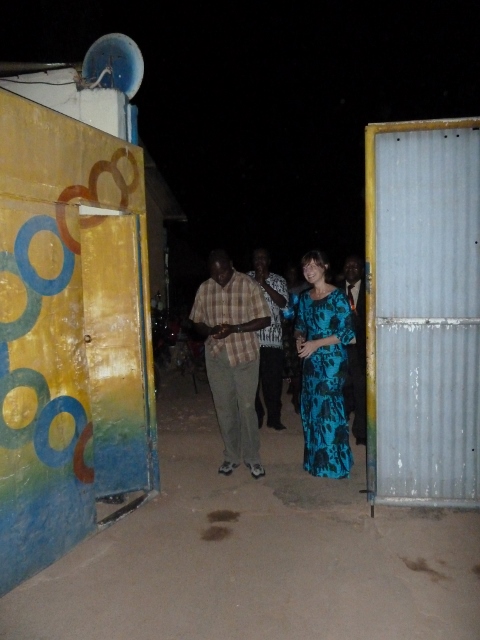


Hours of rhythmic, synchronised, hip-swinging ensued. This was from the Tanzanians. Awkward, out of time knee and elbow jerking was exhibited by the Europeans. Sandra was in huge demand for dancing and photographs. James requested his favourite song "Chop my money" from DJ Stoodio , and Celine Dion was on repeat. The crowd swelled as "Under the Coconut Tree" came on. All was right with the world. A perfect evening to say goodbye under the stars in Nyangao.


Around 1am, without consulting her, the decision was made that it was time for Sandra to leave her own party. In a bit of a rush, midway through drinking a beer and minus her jacket, she was escorted out of Nhamo's surrounded by the committee members and friends - her big pile of presents carried on someone's head. We danced her to the waiting car. We cheered as she climbed in. Waving to her guests, my housemate was driven the 3 minutes back to the home we shared. I guess that meant I'd be walking.


It was an emotional time experiencing Sandra's final week in Tanzania. We were there for her last day at work, shared our last chipsi mayai at the Old Trafford, went for a final run up to the dead baobab tree, ate our last chapattis, and risked our last ride on the dala dala (called "Happy"). Eventually there were no more lasts and it was time to say goodbye. Our time in Nyangao will not be the same without her. Goodbye for now Doctor Sandra. We miss you.


Sunday, 28 July 2013

Home sweet home

At the start of the best UK summer in decades, amid dramatic scenes of a British Wimbledon champion but pre-Royal baby fever, I took a trip to London.

Arriving at Heathrow at 7am on a Saturday, I rode the tube to central with fresh eyes. Still wearing African dress, a "borrowed" Kenya airways blanket around my shoulders and a suitcase full of Tanzanian tea and sachets of gin (why doesn't anyone offer to help me with my bags?), no one says hello or makes eye contact. I top up my Oyster card and touch-in like it's something I've done every day for the last 6 months. It gets busier and I have to move my bags off the seat. I know this because a women told me to - not directly, of course. She's telling me via her friend: "That woman should move her bags. Then you'd be able to sit down". I get the message, discreet as it was. One of the downsides to understanding the local language is that you realise what everyone is saying about you.

It's early morning but all the girls look stunning. Full make-up, perfect hair, clothes as per the latest fashion. All the boys look like girls. Make-up, hair, clothes as per the latest fashion. The smell of perfume is overwhelming after 6 months of inhaling only natural body odours. London is heaving. It's the Trooping of the Colour today - men are in suits and the women in summer dresses and fascinators - it's 10am. I surprise my mum by walking up to her dressed like an African with 40kg of luggage. She's not expecting me home for 1 more day and thinks I'm on a stopover in Addis Ababa when I ring her. Actually, I'm outside Starbucks on Villiers Street. Emotional times.


I've missed: Informative TV shows like The man with the 10 stone testicles or 16 and pregnant. The white van men leering "alright, darlin'?" while you're trapped like a rabbit in the middle of a road. Smooth pavements without potholes or sand. Internet on my phone (it took me 2 hours to remember I had that, so happy) - instant contact again at the swipe of a button. Food. Sleeping without a mosquito net. Indoor toilets. Tap water that is really cold and doesn't taste salty. Tap water that gets really hot. No need for a surge protector. No delay on the phone. But then it's windy. I can't see the milky way or shooting stars. It's very noisy. Chocolate bars are really expensive. I have to use cutlery when I eat and you can't buy medication from the shop, like ketamine or Viagra. It's swings and roundabouts.

My trip to Blackpool on the Megabus was first-class luxury after dala dala experiences. I got my own seat and nobody tried to sit on my lap or give me their baby to hold. My neighbour probably thought I was a nutter when I offered him some of my lunch à la the Tanzanian way. At least it was a whole pear and not half of it. He didn't want to share a sandwich either. I thought the English countryside was beautiful, especially in the evening. The sun doesn't set until 10pm. I could sit outdoors and there was twilight instead of sudden darkness. There were no flies or mosquitoes or lizards rustling the dried leaves and sounding like something much bigger and scarier. I spent time with my baby nephew - though he's not such a baby anymore at 18 months. His Blackpool accent is coming along nicely. "Hiya" and "Cler" are my new favourite words, said with an enthusiasm that only a 1 year old can muster.


With his grand-dad

And London was magical in the sunshine. Like a tourist who sees Big Ben for the first time and stops the stream of commuters in the middle of Westminster bridge to take photos, I stopped the commuters in the middle of the bridge and took photos. The architecture is even more captivating when all you have seen for months are buildings made from concrete and mud. I saw a play in the West End, ate roast duck in China Town, tapas in Covent Garden, hot-dogs in Hyde park, dim-sum in Newham. I climbed to the top of the O2, rolled down a hill in a zorb, Boris-biked, speed-dated, picnicked on Hampstead Heath, ran into the sea at Brighton, had a water-fight with some kids who made me watch their synchronised swimming antics, took a boat trip on Lake Windermere, searched for the ruins of Kendal Castle.


But the best part was doing it all with my family and friends. Nothing beats spending time laughing with the people you love. I loved being home - because that's where you all are xx


Friday, 26 July 2013

Zanzibar nights

Having reached the 6 month mark on my Tanzanian tour of duty I felt I was owed a(nother) holiday and 5 nights on Zanzibar was my gift to myself. The down side was a compulsory night beforehand in Dar Es Salaam and all the stresses of a stay in the big city. I slept at the TEC (Tanzania Episcopal Conference) - I didn't realise it was the centre of the Catholic Church in Tanzania - as if I hadn't been surrounded by enough Nuns, now it was the turn of the Bishop's. I haven't had such a socially awkward dining experience since being invited to a meal in Nyangao and needing to discreetly flick the ants off my chicken drumstick.

I have a new favourite taxi driver in Dar, Nasoro, who shepherded me through the furore at the ferry terminal with the sage advice: "Don't let anyone carry your bags". "Don't let anyone sell you a ticket". "Don't stop walking until you get inside the ticket office". I felt well taken care of and more than a little paranoid. Buying the ticket for the ferry to Zanzibar is the hardest part - fighting the crowd around the ticket sellers who haven't smiled since Christmas and trying to explain that "I am a Tanzanian resident", "I don't want to pay tourist price" and "Please give me a ticket with my own name on it and not my next of kin's" (the British passport can be confusing). Once you have that, the 2 hour catamaran ride across the Zanzibar Channel is pleasant enough, depending on the crossing and the number of passengers throwing up around you. Worryingly, the VSO office does not encourage volunteers to use the ferries after the 2011 and 2012 boat disasters in which hundreds, mostly Tanzanians, died. The government does not maintain the cheaper boats that the locals use - it makes far more money by investing in the "tourist" vessels that draw in more revenue.

The ferries dock in Stone Town where you run a second gauntlet of ticket touts and men luring you to their hotels/taxis/bars. Once you have escaped their clutches and got away with all of your luggage, the next challenge is finding your way through the labyrinth of Stone Town's narrow, twisting alleyways.

The Zanzibar archipelago includes 2 islands; the poorer, north island of Pemba and the main island of Unguja - or Zanzibar for tourists. Both islands are predominantly Muslim unlike the Tanzanian mainland and the adhan can be heard from pre-dawn. The one belonging to the mosque near my guesthouse sounded like a WW2 air-raid siren. Maybe it was. Stone Town was the heart of East Africa's slave trade during the 18th century and at various times in its history the islands have been under the control of the Portuguese, the Omanis and the British before uniting with mainland Tanganyika to form modern independent Tanzania in 1961.

After 6 months in the village, staying in a guesthouse with hot showers, an indoor toilet (en-suite would you believe!), a good fan, choice of breakfast and views over the harbour -  was like being dropped in heaven. Lingering over the roof-top breakfasts, even the pervasive smell of fish from the market below was not enough to dampen my holiday mood.


Some lucky volunteers are based on Zanzibar and others were passing through at the same time as I. We had lots of fun travelling on the local dala dalas, visiting the food stalls at the Forodhani Night Gardens (subsequent food poisoning excepted), spotting the red colobus monkeys in Jozani Forest and pretending to have money ++ at one of the all-inclusive 5* star resorts along the coast. Street stalls sold tiny cups of coffee for 8p which you sipped whilst watching the world go by. The tourist bars sold cocktails for much more than 8p which you could drink as the sun set over the Indian Ocean. Luxury - why don't they need a pharmacist on Zanzibar? 


My dala dala face


Wednesday, 24 July 2013

Mr James' good deed

After receiving a grant of 1.2 million shillings from the Tanzanian Development Trust, my neighbour James, a biomedical scientist/VSO volunteer, was able to organise a series of outreach visits to local villages to test residents for HIV. Having nothing better to do on a Saturday morning in the African bush, I tagged along. Before we went, permission to attend had to be sought from the village elders. Early in the morning stocked up with test kits, lab equipment, HIV counsellors, student medics and a couple of people who needed lifts along the way, we set off. This time we went to the village of Ndawa - only 15km away but a 90 minute drive along sandy tracks into the bush.

On arriving we were introduced to the village elder and given a tour of the school. Later, after setting up in the meeting house and preparing the equipment for testing we awaited willing volunteers. Part of the package was a drum to announce our arrival and encourage participants but sadly today the drum was late.


Ndawa Village school

The Village Elder

The adult rate of HIV in Tanzania is 5.1% which has fallen in recent years. 1.6 million people in the country live with HIV; 230,000 of whom are children. Condom use is low and whilst 48% of women have a comprehensive knowledge of HIV, only 43% of men can say the same. Many misconceptions about the cause, treatment and so-called "cure" for HIV still exist, leading to many dangerous practices and abuses of young girls, in particular. Today, 56 people were tested and received counselling on preventing the disease. Whilst outreach clinics are invaluable for reaching the communities far from hospital based HIV clinics, the question remains whether those who suspect themselves to be infected actually come forward for testing. Over the 2 days of outreach this weekend, 100% of people tested were negative for HIV.


Leading by example and getting tested for HIV

By the afternoon the flow of patients had reduced and we had a look around the village. Some of the group wanted to buy chickens. A couple of hours later having found a man happy to sell his birds and an entertaining time watching them being chased through a corn field, a fair price had been negotiated and the 3 cockerels were trussed up and thrown in the back of the hospital 4x4. It was time to head home dropping off the passengers, counsellors and chickens along the way.


Our driver took a diversion on the way back and we ended up at Namupa; home of Namupa Seminary. The Head Teacher of the boys' school took great pride in showing this unexpected group of visitors around his school which involved looking in every classroom, dorm room and staff room on all 4 floors. The chemistry lab was a nostalgic throw-back to the 1970's, with Bunsen burners right next to the caustic chemicals. No health and safety regulations in force here.


The view from the top of the Seminary

The next day, I watched one of the chickens turned into dinner. Nothing went to waste - liver, heart, testes, stomach, feet, all went into the pot. Only the intestines and lungs are thrown away. An interesting piece of information I gathered in addition to how to kill your own dinner - chickens don't have kidneys (they never pee).


Wednesday, 1 May 2013

Heaven sent from Mars (Incorporated)


I could get used to all these holidays. One of the good things about living in a country with religious diversity is that we get to celebrate the Christian and the Muslim holidays. There are days off for the birth of Jesus, the death of Jesus, the resurrection of Jesus and the birth of the Prophet Mohammed. We commemorate the assassination of Vice President Sheikh Abeid Amani Karume, the anniversary of the overthrowing of the Sultan of Zanzibar, and the unification of Zanzibar with Tanganyika. There's a special day to remember Father of the Nation, Mwalimu Nyerere, then Eid al-Fitr followed 2 months later by Eid al-Adha, and not forgetting Independence Day, Peasant's Day and Worker's Day. It is incredibly diplomatic.

The real challenge is finding places to go on all these days off. Tanzania is so big that it can take days to get somewhere even if transport doesn't let you down. Southern Tanzania in particular doesn't have many draw cards for tourists and the Rough Guide grimly describes most of the places within weekend reach of Nyangao as being "shabby, run down towns in Tanzania's most impoverished region" (anyone still keen to visit?) Which goes some way to explain why on alternate weekends we go to Mtwara, an oasis of civilisation, to stay in the mission-run beach house and wake up by the sea, stock up on treats at the Wazungu supermarket, visit our friends and eat some meat. Lindi is another port town slightly closer than Mtwara, but in my opinion it's a little "shabby and run down". I think in the south of Tanzania at least, once you have seen a few towns you have seen them all. You always find the bus stand near to the market which sells the same goods as everywhere else, with dwellings and stalls spread out along the main road leading to town. It is always sandy, there are always lots of people, goats and bicycles travelling along the road and the colours are always the same; orange and green, orange and green.


Sunrise in Mtwara


The new Alfa Supermarket - spot the Kelloggs


For Easter a group of us travelled to Kilwa, 6 hours dala-dala ride away to see the World Heritage listed 14th century ruins of Kilwa Kisiwani. We treated ourselves to a stay in the nice but expensive Kilwa Seaview Resort, though as volunteers on a budget we squeezed five girls in a room. I was reluctant to stay in a local guesthouse after the guidebook described them as "a profoundly dismal bunch". But then if you believe everything you read, Kilwa's restaurants rarely have anything more than a "sackful of rice in their larders or days-old oily snacks in their display cases". Someone with more positive marketing skills really needs to work for the Rough Guide.


Kilwa Masoko Bay


Kilwa Kisiwani ruins


Easter morning breakfast

Last weekend in honour of Union Day we spent the public holiday relaxing by the pool at The Old Boma Hotel in Mikindani. In days gone by, Mikindani was one of the coast's major seaports for ivory and slave-trading caravans and was supposedly the site of Livingstone's camp in 1866 at the start of his final exhibition to the Great Lakes. For an afternoon I was just a tourist, lying on a sun-lounger at "southern Tanzania's best hotel" with the smell of chlorine in the air, monkeys in the trees and a ice-cold ginger beer in my sun-burnt hands. Then we left the beautiful, colonial surrounds of the old boma and were spat back out into the real Africa with the sand and the smells and street stalls selling octopus tentacles for dinner. To complete the holiday feeling we discovered a place that sold ice-cream and ate caramel flavoured vanilla ice whilst keeping one eye on our shopping bags and ignoring the flies and the traffic fumes. I found a shop that sold Twix. Not even my favourite chocolate bar but that gold and red wrapper made me very happy.


The Old Boma, Mikindani


Today we are celebrating Worker's Day hence a Wednesday off work. Yesterday afternoon there was a sherehe, or party, for all the hospital staff. Having been to a hospital sherehe before, I knew better than to arrive on time and had planned to turn up just after the 3 hours of speeches had finished but before the food, though my absence would be noted as one of only 3 white people in the crowd. In the end I thought better of it and sat through the formalities, which is less like a party and more like a protracted torture one must go through to get a free soda and a plate of pilau. The scrum for food was something to behold once the speeches were over. Somehow I got squashed in the middle of a particularly pungent group of workers who were even more excited than me at the prospect of a free meal. Still trying to decide which animal the one piece of meat on our plate came from.  

So, happy Worker's Day to you all. I think I will use my time wisely and watch lots of American TV shows whilst I wait for James' promised barbeque this evening. A meal with minced meat is a meal fit for a queen. I'm already looking forward to our next public holiday - International Trade Fair Day...what a great country I live in.